
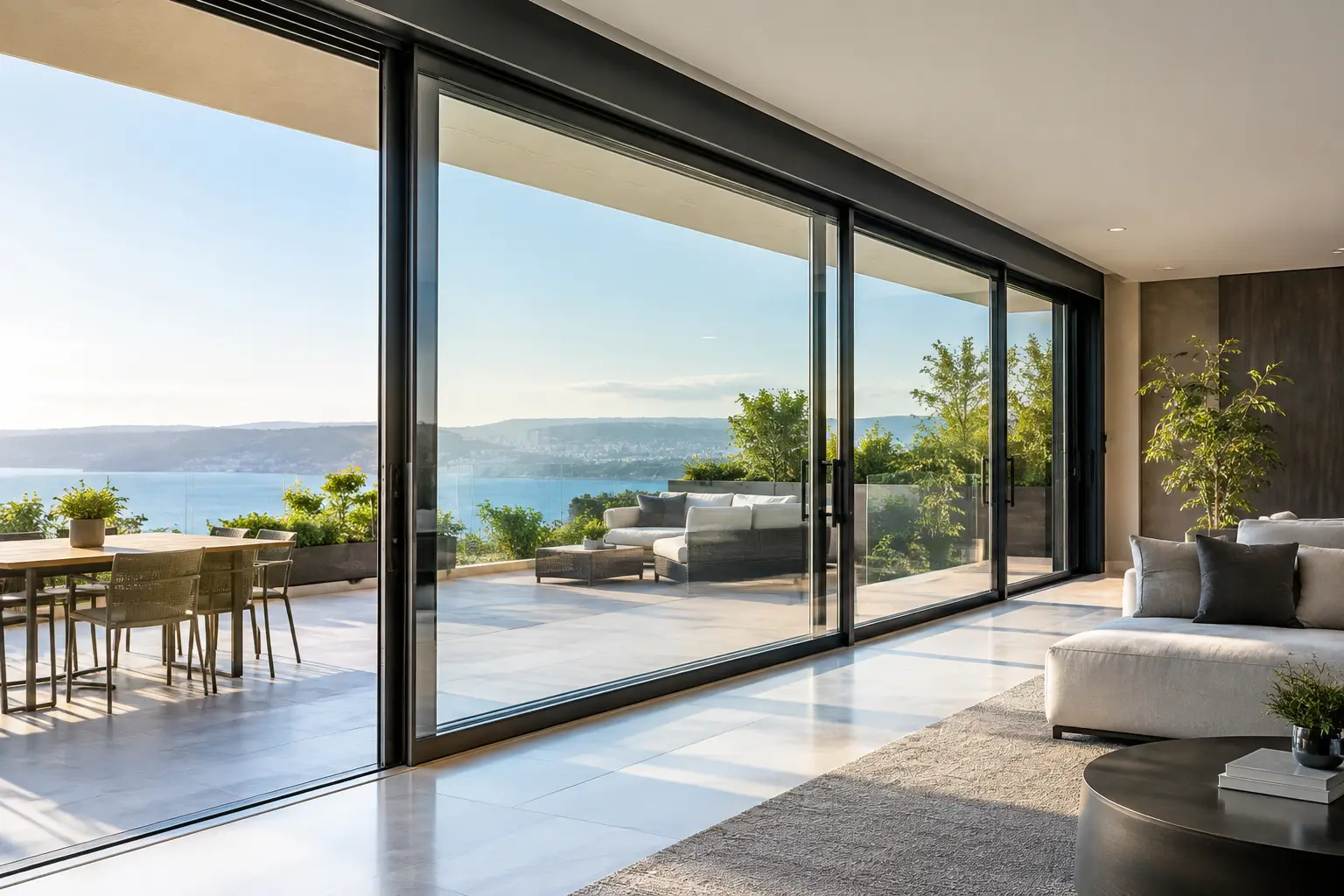
The Hebe-Schiebe (lift-and-slide) system is a specially engineered aluminum sliding door system that allows large glass panels to be lifted slightly from the frame while sliding and lowered into full contact with the seals when closed. Compared with conventional sliding systems, it offers higher thermal and acoustic insulation, better air and water tightness, and the ability to close much wider openings with single-piece glass panels. In this guide, we explain in detail how the Hebe-Schiebe system works, how it differs from conventional sliding systems, its advantages and disadvantages, selection criteria, and frequently asked questions.
What Is the Hebe-Schiebe System?
Hebe-Schiebe is a term derived from the German words “heben” (to lift) and “schieben” (to slide), and it is the general name for aluminum lift-and-slide door systems. In this system, the sashes rise a few millimeters above the track during movement using a special lifting mechanism; when the sash closes, it lowers under its own weight until it makes full contact with the special seals on the bottom track. This simple yet effective mechanism provides both easy operation and high sealing performance.
How Does It Work?
- When the sash handle is turned, the sash is first lifted slightly from the track.
- The lifted sash slides horizontally with ease on roller carriages.
- When the sash is stopped at the desired position and the handle is turned again, it lowers and seats firmly against the seals.
- Thanks to this lifting and lowering movement, the sash moves without friction when open and becomes fully airtight when closed.
Key Components
- Reinforced aluminum profile frame and sash system
- Special hardware and locking systems with a lift-and-slide mechanism
- Bearing-equipped roller carriages capable of carrying heavy loads
- Multi-point brush and rubber seals
- Thermally insulated profile sections with a thermal barrier
- Single- or double-glazed insulated glass units
Differences from Conventional Sliding Systems
In a conventional sliding system, the sash continuously contacts the bottom track while sliding from side to side, making it a simpler and more economical type of joinery. The Hebe-Schiebe system supports this movement with a lifting mechanism, providing less friction, less wear, and higher sealing performance. The table below compares the two systems across key categories.
| Feature | Conventional Sliding System | Hebe-Schiebe System |
|---|---|---|
| Movement Mechanism | The sash slides while continuously contacting the track | The sash lifts first, then slides, and seats again when closed |
| Airtightness and Watertightness | Moderate | High, with tight multi-point contact |
| Thermal and Acoustic Insulation | Standard | Higher insulation performance |
| Sash Weight Capacity | Limited | High; suitable for heavy and large glass panels |
| Maximum Opening | Suitable for smaller openings | Suitable for large-opening sliding door applications |
| Ease of Use | Friction may increase over time | Smoother operation over the long term |
| Cost | More economical | Higher initial investment cost |
Thermal and Acoustic Insulation
The thermally insulated sliding door profiles used in Hebe-Schiebe systems significantly reduce heat transfer between indoor and outdoor environments through thermal barrier technology. Multi-point sealing systems and the tight contact between the sash and frame minimize air leakage and contribute to energy efficiency. When used with double-glazed insulated glass units, acoustic insulation also improves significantly, which is an important advantage especially for homes and terraces near busy streets. Keep in mind that actual performance depends on profile thickness, glass type, seal quality, and installation workmanship.
Airtightness, Watertightness, and Security
When the sash closes, the lift-and-slide mechanism ensures full contact with the seals around the entire perimeter; this significantly improves resistance to water and wind compared with conventional sliding systems. Security can be enhanced with multi-point locking systems, reinforced hardware, and optional laminated or tempered glass. Nevertheless, the final level of airtightness, watertightness, and security is directly related to proper installation, high-quality sealing materials, and the quality of the selected hardware.
Advantages for Large Openings
Hebe-Schiebe systems are preferred for large openings because their powerful bearing-equipped carriages and reinforced profiles can safely carry heavy, large-format glass panels. This feature meets the need for large-opening sliding doors in villa and residential projects that seek to connect terraces and gardens with interior spaces seamlessly, as well as in commercial buildings opening onto scenic views. The use of wide, single-piece glass provides significant advantages in terms of both aesthetics and natural daylight.
Architectural Applications
- Terrace-to-interior transitions in residential and villa projects
- Balcony enclosures and large balcony glazing
- Winter gardens and veranda applications
- Scenic façades in commercial buildings such as restaurants, hotels, and offices
- Openable façade solutions for poolside and garden areas
Advantages and Disadvantages
Advantages
- High airtightness, watertightness, and insulation performance
- Capacity to carry large and heavy glass panels
- Long-lasting, low-friction operation
- Slim profiles and a wide glass appearance for strong aesthetics
Disadvantages
- Higher cost than conventional sliding systems
- A more complex hardware structure that requires proper installation
- Periodic maintenance is required, including track and mechanism cleaning
What to Consider When Choosing
When choosing a Hebe-Schiebe system, consider more than just the brand, because final performance depends on the combination of profile, glass, seals, hardware, and installation quality.
- Profile section and thermal barrier quality
- Glass type, thickness, and insulated glass structure (double/triple glazing, Low-E coating, etc.)
- Seal material quality and the number of sealing points
- Hardware load capacity and bearing quality
- The installer’s experience and installation warranty
- Accurate calculations for opening dimensions, sash count, and loads for the specific project
Maintenance and Operating Recommendations
- Regularly clean the tracks and roller carriages of dust and dirt
- Lubricate moving mechanisms at least once a year according to the manufacturer’s recommendations
- Check the seals for wear and replace them when necessary
- Avoid applying excessive force when opening and closing the sashes
- Periodically make sure that the locking and handle mechanisms operate correctly
Frequently Asked Questions
How much more expensive is a Hebe-Schiebe system than a conventional sliding system?
Although costs vary depending on the profile brand, glass type, and opening dimensions, Hebe-Schiebe systems are generally priced higher than conventional sliding systems because of their advanced mechanisms and insulation features.
What size openings can Hebe-Schiebe doors be manufactured for?
Depending on the system and profile brand, Hebe-Schiebe joinery can be designed to accommodate openings several meters wide and heavy glass panels; consult the manufacturer’s technical data for exact dimensions.
Is thermal insulation really better than with conventional sliding systems?
The general tendency is yes; multi-point seals and the sash seating fully in place reduce air leakage. However, final performance depends on the insulation values of the glass and profile used.
Is a Hebe-Schiebe system difficult to maintain?
No; with regular cleaning and simple lubrication once a year, the system can operate reliably for many years.
For terrace and balcony applications, is Hebe-Schiebe or conventional sliding more suitable?
Hebe-Schiebe systems may be preferred for terrace and balcony projects with wide openings and high expectations for insulation and sealing; conventional sliding systems may be suitable for smaller, budget-focused applications.
What types of glass can be used in a Hebe-Schiebe system?
Options such as double-glazed insulated glass units, Low-E-coated glass, and laminated or tempered safety glass can be selected according to the project requirements.
How should I choose the right supplier?
We recommend requesting a detailed quotation, including warranty terms, from a company that evaluates profile, glass, hardware, and installation quality together, has reference projects, and provides technical support.
Conclusion
The Hebe-Schiebe system is an advanced aluminum lift-and-slide door solution that offers higher thermal and acoustic insulation, better sealing, and safe operation across large openings compared with conventional sliding systems. It is a strong alternative for residential, villa, terrace, balcony, winter garden, and commercial building projects seeking wide glass surfaces and easy operation. However, actual performance depends on the quality of the selected profile, glass, seals, and hardware, as well as the workmanship of the installer. To determine the most suitable solution for your project, consult a specialist who carefully compares the technical details and provides a clear quotation after measurement and site assessment.
Bir yanıt yazın